Home › Buyer’s Guides › iPhone trade-in values
iPhone trade-in value in Australia: what the 12, 13, 14 and 15 are actually worth
Apple will not tell you what your phone is worth until you hand over its serial number. The independent buyers will. Here is what each model fetches in November 2026, read from the quote pages the same morning this was published — and the part nobody advertises, which is how much more the phone sells for once it leaves your hands.
Short answer. In November 2026 an Australian buyback service pays roughly A$190 for an iPhone 12, A$300 for an iPhone 13, A$360 for an iPhone 14 and A$550 for an iPhone 15, at 128GB and in good condition. The single biggest drop is between the 13 and the 15 — two years of age costs you A$250. Trading in at Apple is more convenient and gives you credit rather than cash, and Apple does not publish a per-model figure at all.
What each model is worth right now
These are the quotes Mobile Monster was showing on 28 November 2026, read directly from its own per-model pages. Two numbers are quoted for each phone: the offer for a device in top condition, and a lower figure you can accept instead if yours does not qualify. Both are shown here, because the second one is what a lot of people will actually be paid.
| Model | 128GB | 256GB | If it doesn’t make top condition |
|---|---|---|---|
| iPhone 12 | A$190 | A$190 | A$130 |
| iPhone 13 | A$300 | A$340 | A$240 / A$280 |
| iPhone 14 | A$360 | A$390 | A$330 |
| iPhone 15 | A$550 | A$600 | A$510 / A$560 |
Source: mobilemonster.com.au model pages, read 28 November 2026. Quotes move; confirm on the day you sell.
Three things that table tells you
Storage stops mattering on older phones. The iPhone 12 pays exactly the same at 128GB and 256GB — A$190 either way. On the iPhone 15 the same upgrade is worth an extra A$50. If you paid A$150 more for extra storage on a phone you are now selling four years later, you will not see a cent of it back.
The 13 to 15 gap is where the money is. A$300 against A$550. Two model years cost you A$250, which is more than the entire value of an iPhone 12. If you are deciding whether to sell this year or next, that is the number to weigh.
Condition is worth less than people fear, except on old phones. Dropping below top condition costs A$30 on an iPhone 14 but A$60 on an iPhone 12 — and on the older phone that is nearly a third of the total. Scratches matter proportionally more the less the phone is worth.
The battery rule that quietly costs you $30
Mobile Monster applies a condition most sellers do not notice until the inspection: if the device reports less than 90% battery health, it is automatically valued at the "As New" price instead and the A$30 bonus is lost. Check yours before you quote — Settings, Battery, Battery Health. It takes ten seconds and it is the difference between the number you were promised and the number you are paid.
What Apple pays, and why you cannot find out
Apple Australia does not publish a trade-in value for any individual iPhone. The trade-in page hands you to Likewize, Apple’s Australian trade-in partner, which will not quote anything until you enter your IMEI. This is different from the United States, where Apple publishes a per-model table you can read without identifying your device.
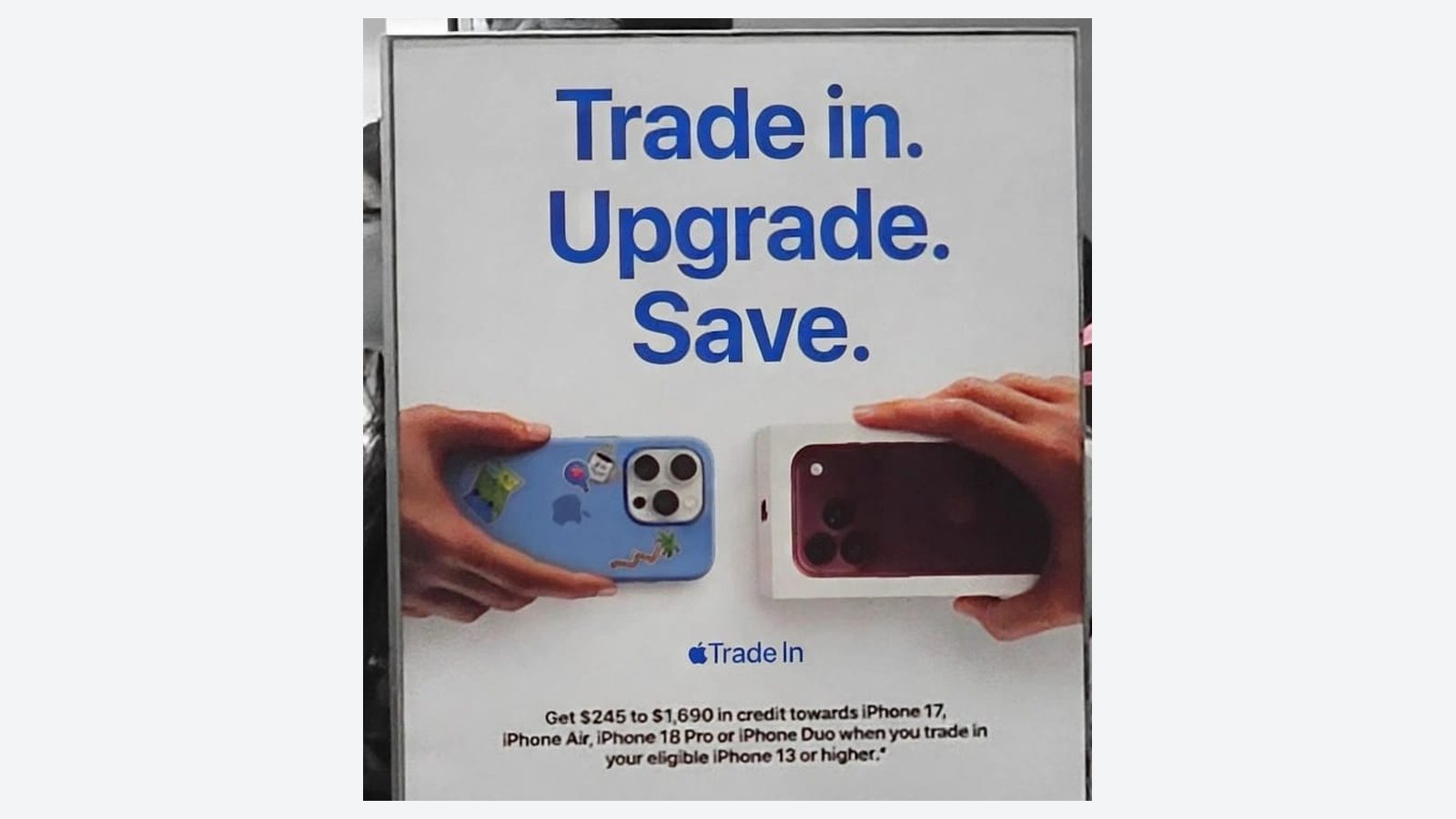
What Apple does publish is a range tied to the phone you are buying. In-store signage photographed in an Australian Apple Store on 28 November 2026 advertised A$245 to A$1,690 in credit towards an iPhone 17, iPhone Air, iPhone 18 Pro or iPhone Duo, for an eligible iPhone 13 or higher. The floor of that range is the number that matters to most people, because the ceiling assumes you are trading a nearly new Pro Max.
Two things follow from that. The first is that A$245 for an iPhone 13 is less than the A$300 cash a buyback service will pay you for the same phone — and the Apple figure is store credit, not money. The second is that Apple’s own fine print on the iPhone 17 page states its advertised with-trade-in pricing is "calculated based on the trade-in value of iPhone 15 128GB in good condition", so the headline monthly figure assumes you own a fairly recent phone.
The number nobody shows you: what happens to your phone next
This is the part a comparison site is for. We track what refurbished iPhones sell for in Australia, so we can put the buyback quote beside the resale price of the identical model and storage.
| Model (128GB) | You are paid | It resells for | Margin |
|---|---|---|---|
| iPhone 14 | A$360 | A$476 | +A$116 (32%) |
| iPhone 15 | A$550 | A$664 | +A$114 (21%) |
Buyback quotes from Mobile Monster, 28 November 2026. Resale prices are the lowest verified refurbished listing we track for the same model and storage — see Best Buys.
Around A$115 per handset, on both models. That is not a scandal: it pays for testing, battery replacement where needed, data erasure, warranty, returns and the risk that the phone turns out worse than described. It is the business. But it is worth knowing that the gap is roughly fixed in dollars rather than percentage — which means it costs you proportionally far more on a cheap phone than an expensive one. On an iPhone 12 at A$190, a A$115 spread would be most of the value of the device.
The practical conclusion: the older and cheaper your phone, the more it is worth selling privately rather than to a buyback service, because the fixed handling cost eats a larger share. Above about A$400, the convenience and the guaranteed payment usually win.
Trade in, sell to a buyback service, or sell privately?
- Apple trade-in — easiest, and the credit applies instantly against a new phone. You cannot see the figure before committing, and it is credit rather than cash. Best if you were buying a new iPhone from Apple anyway.
- Buyback specialist — publishes a price before you commit, pays actual money, typically within days. You post the phone and accept the risk of a revised offer after inspection.
- Private sale — the highest number, and the only route that captures the margin above. Costs you time, meeting strangers, and the possibility of a payment dispute with no protection.
Our guide to what your phone is worth covers the timing question — which month to sell in — in more detail, and the trade-in estimator gives a quick figure for models not listed here.
Before you accept any quote
- Check battery health first. Below 90% changes the offer at most buyers, and below 80% changes it sharply.
- Get two quotes. Buyback prices for the same phone differ by more than most people expect, and the quote costs nothing.
- Turn off Find My and sign out of iCloud before posting. A locked device is worth nothing to anyone and will simply be returned.
- Photograph the phone before you send it, including the screen powered on. It is your only evidence if the condition is disputed.
- Read what happens if they revise the offer. You should be able to reject a revised value and have the phone returned free of charge.
Common questions
How much is my iPhone 13 worth in Australia?
About A$300 for the 128GB model in good condition, or A$340 at 256GB, based on quotes read on 28 November 2026. If the device does not meet top condition, expect A$240 to A$280. Apple’s in-store trade-in signage put the floor of its credit range at A$245 for an eligible iPhone 13 or newer, which is less than the cash offer and comes as store credit.
Is it better to trade in at Apple or sell to a buyback service?
If you are buying a new iPhone from Apple, trading in is simpler and the credit is applied immediately. If you want money rather than credit, or you are not buying from Apple, a buyback specialist publishes its price up front and generally pays more. For an iPhone 13 the difference was about A$55 in the buyback service’s favour at the time of writing.
Does storage size change my iPhone’s trade-in value?
Less than you would think, and not at all on older models. An iPhone 12 fetches A$190 whether it is 128GB or 256GB. On an iPhone 15 the 256GB model is worth about A$50 more than the 128GB. Storage premiums do not survive depreciation.
Why will Apple not tell me my trade-in value in Australia?
Apple Australia’s trade-in service is run by a partner, Likewize, which quotes per device rather than per model and requires your IMEI before it will show a figure. Apple publishes only a credit range tied to the new phone you are buying. In the United States Apple does publish a per-model table, so this is a difference in how the programme is run locally, not an Apple-wide policy.
What battery health do I need for the best trade-in price?
90% or above at the service quoted here. Below that the device is automatically valued at the lower "As New" price and a A$30 bonus is forfeited. Check in Settings, then Battery, then Battery Health.
Should I sell my iPhone 12 or keep it?
At A$190, an iPhone 12 is close to the point where selling is barely worth the effort — particularly once a buyback service takes its margin, which on cheaper phones can approach the value of the handset. Keeping it as a spare, handing it on, or selling privately will usually serve you better than a trade-in.