Home › Industry News › New phone sales fall 12%
New phone sales fell 12%. Here is what the refurbished sellers filling the gap actually offer
Australian new-phone volumes dropped 12% in the first half of 2026 as memory costs pushed handset prices to record highs. Refurbished sellers say they are growing at double-digit rates. We checked what those sellers publish, and the warranty on offer ranges from three months to twenty-four.

In short. NIQ’s sales panel shows new smartphone volumes in Australia fell 12% in 1H 2026 year on year, reported by ChannelNews on 21 October 2026. Globally, IDC’s preliminary figures put third-quarter shipments down a record 22% year on year to 255.3 million units. Refurbished resellers report double-digit growth — but NIQ also notes Australia has no reliable local volume figures for the second-hand market, so that growth is self-reported. What can be checked is what sellers publish. Of the Australian sellers we track, three publish a 24-month warranty, most publish 12, and one publishes three.
What the numbers actually show
The fall is not a blip and it has been accelerating. IDC’s figures put global shipments down 2.9% year on year in the first quarter and 7.4% in the second, before the third quarter’s 22% collapse to 255.3 million units. Counterpoint Research put the same quarter at 20%. IDC’s own full-year forecast has been revised downward three times: a 12.9% contraction predicted in February, 13.9% in May, then 16.7% in August — which would be the steepest decline in the history of the smartphone market. IDC’s senior research director for worldwide devices, Nabila Popal, put it bluntly: “The worst is yet to come.”
The top of the market consolidated as the floor fell out. Samsung shipped 57.8 million units in the quarter and Apple 57.3 million, against 61.4 million and 59.7 million a year earlier. Both shipped fewer phones and both gained share — Samsung to 22.6%, Apple to 22.4% — because the Chinese brands fell further. Oppo dropped to 25.6 million from 39.1 million, a third of its volume gone in a year.
The cause is memory, and it reaches Australian price tags
The driver is a sharp rise in memory costs, with IDC tipping a 12% increase. That is a component story, but it arrives in Australia as a retail one. Apple, Samsung, Oppo and Motorola have all lifted local prices, and Samsung Australia added A$150 to the price of the base Galaxy S26. Korean outlet MoneyToday reported that Samsung has cut fourth-quarter smartphone production by 30% as memory costs erode margins — a manufacturer choosing to make fewer phones rather than sell them thinner.
We covered the pricing side of this when Samsung and Google raised prices on handsets already on sale, and the longer arc in Australia’s average new phone heading for A$1,253. What is new is the volume response: Australians are not paying the higher prices. They are holding their phones longer, or buying someone else’s.
The growth claim nobody can verify
Here is where we part company with most coverage of this story. Refurbished resellers are reporting double-digit growth, and that is probably true. But NIQ says plainly that Australia has no reliable local volume figures for the second-hand market. There is no panel, no registry, and no independent count. Every “refurbished is booming” number in circulation traces back to sellers describing their own businesses.
The demand research is softer still. Figures cited in the ChannelNews report say more than a third of adult Australians planning an upgrade would probably buy refurbished, and that 75% of current new-phone owners would consider one next time, particularly if it lets them step up to a better model. One carrier forecasts the segment growing at a 9% compound annual rate to 2029. We have not seen the underlying samples or methodology for any of those, and stated purchase intent is a poor predictor of purchase. Treat them as directional, not as measurements.
We are in no position to be smug about this: our own market-size figures are industry estimates and we label them as such. The honest position is that the direction of travel is well evidenced and the magnitude is not.
What can be checked: the warranty spread
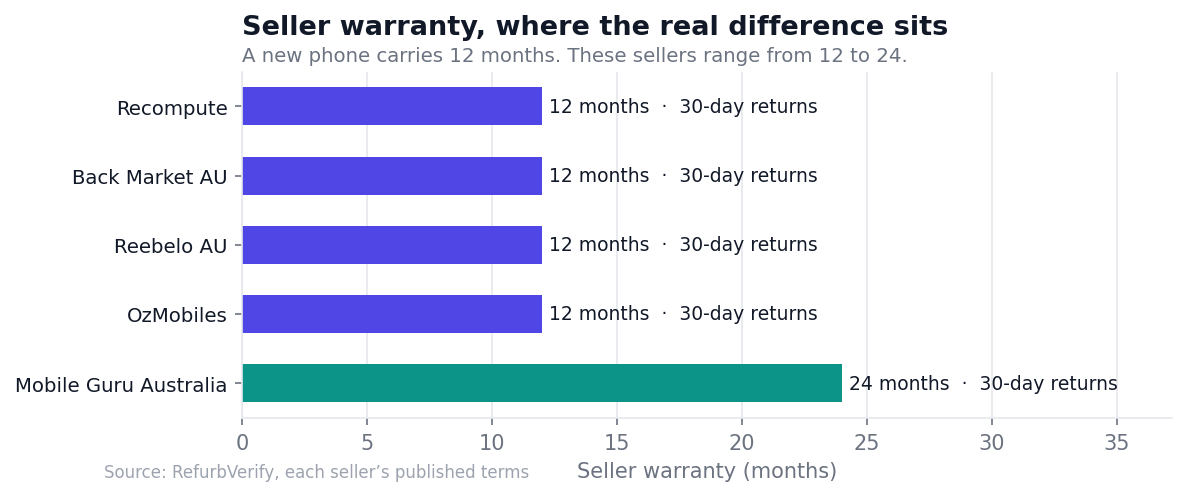
The ChannelNews report notes that online retailers are building trust by offering warranties of up to 24 months. That is accurate, and it understates how wide the range is. “Up to” describes the ceiling. Across the Australian sellers whose published terms we record:
| Published warranty | Sellers |
|---|---|
| 24 months | Mobile Guru Australia, OZ Tech Deals, Regood |
| 12 months | The majority, including OzMobiles, Green Gadgets, Frank Mobile, Certified Tech Direct |
| 3 months | Roobotech |
A new iPhone or Galaxy bought in Australia ships with a 12-month manufacturer warranty. So the top of the refurbished market now offers double the cover of a new phone, and the bottom offers a quarter of it. That spread — 3 months to 24 — is a bigger difference than most of the price gaps between sellers, and it is the thing least likely to be on the product page you are looking at.
Longer warranties are also a rational response to the underlying problem. If a seller is confident in its testing, cover is cheap to offer and it is the clearest signal available to a buyer who cannot inspect the device. It is worth more than a grade word.
Where the device was refurbished matters
The same report notes that many of the online retailers growing fastest are Asian-owned businesses that refurbish offshore and ship handsets back to Australia. That is not a quality judgement — offshore refurbishment can be excellent and is how much of the global supply chain works. It is a remedy question. Australian Consumer Law guarantees attach to the business you bought from, so if that business has an Australian presence your rights are straightforward. If the seller is offshore with no local entity, enforcing a guarantee is harder regardless of what the warranty says.
This is part of why our score separates refurbishment transparency from operational legitimacy: a business can be clear about grading and still be difficult to hold to account. See how we rank.
The UK is the useful comparison
NIQ describes Australia’s refurbished market as underdeveloped against mature markets, and the UK is the instructive one. There, refurbished phones account for close to one in ten smartphone sales and are growing about 14% a year, while new phone sales fell 7%. NIQ draws the conclusion that refurbished devices are not cannibalising new ones — the two are serving different buyers at different moments.
If Australia follows that path, the interesting consequence is not volume. It is that a market with one in ten sales refurbished develops the infrastructure a market with one in thirty does not: grading that means something across sellers, warranties that compete, and independent data on who is reliable. Right now Australia has sellers competing on price and very little competing on anything a buyer can check.
If you are buying in the next few weeks
With Black Friday on 27 November, the practical advice is unchanged by any of this. The saving on refurbished is large and durable — a refurbished handset sits well below new recommended retail every day of the year, which is exactly why a sale-day percentage badge tells you so little. Four things to confirm before you pay, in this order:
- The warranty, in months, in writing. Given the range above, this is the single most variable term in the market.
- A stated minimum battery health. The battery is the part that fails; a cosmetic grade says nothing about it.
- What the grade word means at that seller. Use the grade translator.
- Whether the seller has an Australian presence. It determines how easy a remedy is to obtain.
Current prices across the sellers we track are on Best Buys, with the date they were last checked shown on the page.